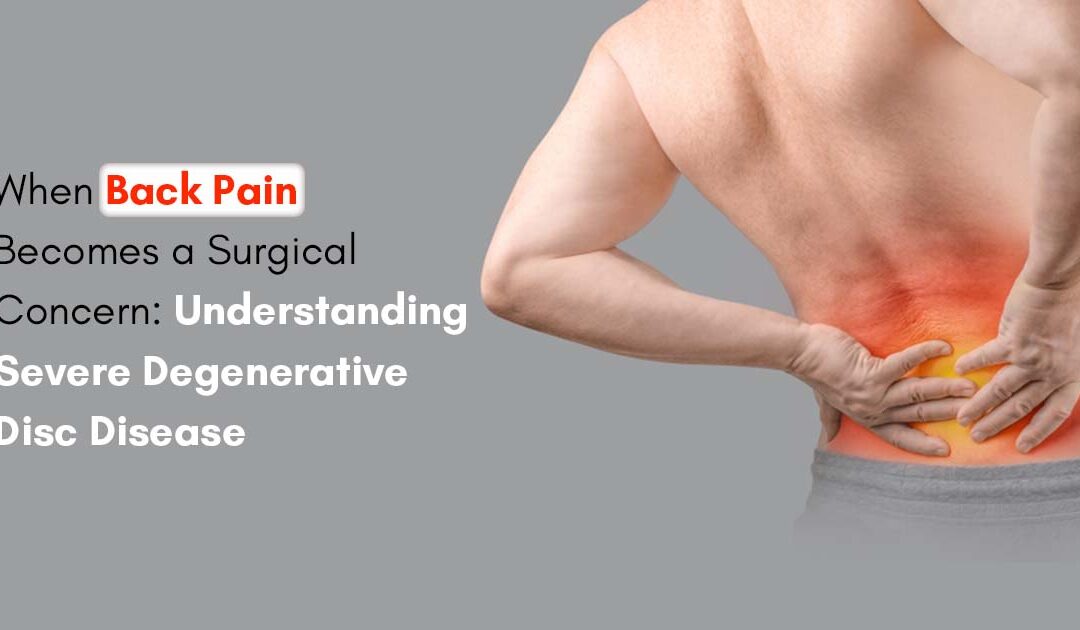
Back pain is among the most widespread complaints about health in the world, affecting millions of people of all ages. While most back pain is from muscle strain or poor posture, degenerative disc disease (DDD) can be a more serious and enduring contributor to long-term pain. Severe forms may require surgery but can often be managed conservatively and through lifestyle modifications.
In this blog, we will produce a discussion of degenerative disc disease, including why it occurs, when back pain should lead to concerns of surgery, and what treatment options there are(including surgery) to restore function and reduce pain.
What is Degenerative Disc Disease?
Despite the term “disease” in its name, degenerative disc disease is not actually a disease. It is a description of the natural wearing down of spine discs as a part of aging.
The spine is made up of a series of vertebrae cushioned and stabilized by intervertebral discs, which are soft, gel-like structures that provide shock absorption, stability and allow range of motion. As a spine ages (or is damaged), it becomes more dehydrated (and loses elasticity) and reduces the supportive function of these discs as cushion and support.
As the discs in your spine are degenerating, you may experience the following:
- Chronic back or neck pain
- Pain that radiates to legs or arms
- Numbness or tingling due to nerve compression
- Restriction in range of motion and stiffness
As degeneration becomes worse, you may develop a herniated disc, unstable spine, or compressed nerve root, which may necessitate a surgical procedure.
Why do degenerative disc diseases happen?
Disc degeneration can be a natural part of aging, but several variables can cause a more rapid rate of degeneration, which includes:
- Genetics: Some patients have a genetic predisposition to a faster rate of wear of their discs.
- Repetitive Strain: Occupations or modalities that involve regular heavy lifting, or sitting for long periods of time.
- Poor Posture: Slouching and poor ergonomics creates more stress on the spine.
- Smoking: Smoking inhibits blood flow, therefore shortening the nutrient supply to the discs, promoting degeneration.
- Injury: A history of spinal injury can cause you to degenerate a disc at an earlier age.
After time, discs will lose height, bulging, or tear, which leads to bone on bone contact and irritation of surrounding nerves, which is the leading cause of chronic pain.
Symptoms That Shouldn’t Be Ignored
Mild episodic back pain is very common, and usually improves with rest and/or a course of physiotherapy. But for patients with severe degenerative disc disease, pain can become chronic and disabling. Here are some warning signs that might indicate a potentially serious issue.
- Chronic, intense pain in the lower back or neck lasting over 3 months
- Discomfort extending to the legs (sciatica) or arms
- Loss of sensation, prickling, or lack of strength in the extremities
- Discomfort that intensifies with movement and restricts everyday activities.
- Struggling to stand, walk, or carry out simple activities
- Loss of control over bladder or bowel functions (a medical emergency signaling nerve compression)
When Back Pain Turns into a Surgical Issue
Surgery for degenerative disc disease is generally viewed as an option when:
- Conservative treatments do not succeed: Non-surgical methods such as medications, physical therapy, lifestyle modifications, or epidural injections fail to offer enduring relief after months of use.
- Significant disc damage is apparent: MRI or CT imaging reveals considerable disc collapse, herniation, or spinal instability.
- Nerve compression takes place: When the damaged disc puts pressure on spinal nerves, resulting in intense leg pain, numbness, or weakness.
- Impaired mobility or neurological issues: If nerve function is affected or daily activities become difficult due to pain.
At this point, surgery can assist in stabilizing the spine, alleviating pressure on nerves, and restoring functionality.
Surgical Treatment Alternatives
The selection of surgical procedure relies on the degree and site of disc degeneration, in addition to the individual’s general health and way of life. Frequent surgical operations consist of:
1. Discectomy –
A discectomy entails excising the affected part of a herniated or deteriorated disc that is exerting pressure on adjacent nerves. It is slightly invasive and frequently offers rapid pain alleviation, particularly in instances of sciatica.
2. Spinal Surgery –
In cases of advanced degenerative disc disease, spinal fusion might be advised. The surgeon excises the damaged disc and joins two or more vertebrae using bone grafts and metal implants. This stabilizes the spine and stops painful movement between the impacted segments
3. Artificial Disc Replacement (ADR)
For selected patients, artificial disc replacement is an advanced alternative to fusion. This procedure involves replacing the damaged disc with an artificial one that preserves movement. It is usually suitable for younger patients with isolated disc degeneration and no significant arthritis.
4. Laminectomy or Decompression Surgery
When disc degeneration is accompanied by spinal stenosis, or narrowing of the spinal canal, laminectomy is performed to remove a portion of the vertebral bone and ease pressure on the spinal cord and nerves.
Recovery and Rehabilitation
Recovery following spine surgery is based on the type of procedure and general health of the patient. Minimally invasive surgeries generally permit faster recovery, with patients often returning to light activities in a few weeks.
Optimal results require a comprehensive rehabilitation program, which includes the following:
- Physical therapy will help restore mobility, strength, and flexibility.
- Posture correction and ergonomic adjustments: This will prevent recurrence.
- Return to daily activities gradually: guided by medical supervision.
- Lifestyle modification: Weight control, regular exercise, and avoidance of smoking ensure long-term spine health.
Prevention: Caring for Your Spine Before It’s Too Late
While it is impossible to completely avoid disc changes with increasing age, it is possible to prevent further degeneration of the condition and its complications by avoiding certain habits:
- Keep a healthy weight to put less pressure on the spine.
- Engage in core-strengthening exercises to support your back.
- Practice good posture when sitting, standing, and lifting.
- Avoid smoking and excess alcohol consumption.
- If your work requires sitting for long hours, then take breaks often.
Conclusion
Severe degenerative disc disease is more than just chronic back pain; it’s a progressive condition that can limit mobility and independence. Although medications and therapy remain the first line of defense, surgery becomes necessary if the nerve compression or instability of the spine threatens long-term function.
Modern surgical advancements in minimally invasive spine surgery and artificial disc replacement provide safer, quicker, and more effective results than ever before. If your back pain has become persistent, disabling, or resistant to conservative treatment, consult a spine specialist. Early evaluation and the right intervention can make the difference in living in pain versus reclaiming an active, pain-free life.